
AI chatbot development cost is most valuable when it is treated as an operating capability rather than a demo. At AUREXONE AI TECHNOLOGIES, the practical question is how the idea fits real data, systems, users, controls, and measurable business outcomes. This guide explains the decisions that matter before implementation, the architecture and workflow choices that shape reliability, and the evaluation steps that help teams move toward production without relying on inflated claims or untested assumptions. This keeps AI chatbot development cost connected to measurable workflow outcomes rather than novelty.
For decision-makers, AI chatbot development cost should answer a concrete need: reduce avoidable manual work, improve response quality, shorten a decision cycle, surface better information, or make a controlled action easier to complete. The best starting point is a bounded workflow with known owners, observable inputs and outputs, and enough baseline data to judge whether the new approach is actually better.
Key Concepts to Align Before You Build
Useful planning language for this topic includes AI chatbot, conversational AI, customer support, human handoff, conversation design, voice agent, lead qualification. These concepts should not become buzzwords. Each one needs a practical definition tied to the workflow, technical boundary, decision owner, and acceptance test for this specific project. For leadership teams, AI chatbot development cost is easier to approve when ownership and operating limits are visible.
A good discovery phase for AI chatbot development cost maps who initiates the process, what data is required, where context comes from, which systems can be read or changed, what exceptions occur, and who owns the result. That map becomes the foundation for architecture, security, evaluation, and change management.
Define the economic baseline
The central challenge in AI Chatbot Cost is rarely the model alone; it is how define the economic baseline fits into the surrounding workflow, data, controls, and ownership model. In a real workflow this can include answering policy questions, resolving routine requests, collecting context before escalation, or handing complex cases to agents. Each path needs a clear input, an expected output, a system of record, and a defined response when confidence is low or a dependency fails. That is why teams should make AI chatbot and conversational AI explicit in the design. The goal is not to add more components; it is to reduce ambiguity about what the system may do, which data it may use, and how success will be verified. A strong implementation also separates model quality from workflow quality. A response can sound correct while the downstream action is wrong, duplicated, delayed, or sent to the wrong destination. Production acceptance therefore needs checks at both levels and a rollback or manual path when the automated path is not trustworthy. This framing keeps the initiative tied to business process reality and makes later decisions about scale, cost, security, and support easier to defend. A phased AI chatbot development cost rollout also makes technical and business learning easier to separate.
Map development and operating cost drivers
For AI Chatbot Cost, the most useful starting point is to connect map development and operating cost drivers to a specific operating outcome rather than to a generic AI capability. In a real workflow this can include answering policy questions, resolving routine requests, collecting context before escalation, or handing complex cases to agents. Each path needs a clear input, an expected output, a system of record, and a defined response when confidence is low or a dependency fails. That is why teams should make conversational AI and customer support explicit in the design. The goal is not to add more components; it is to reduce ambiguity about what the system may do, which data it may use, and how success will be verified. A strong implementation also separates model quality from workflow quality. A response can sound correct while the downstream action is wrong, duplicated, delayed, or sent to the wrong destination. Production acceptance therefore needs checks at both levels and a rollback or manual path when the automated path is not trustworthy. This framing keeps the initiative tied to business process reality and makes later decisions about scale, cost, security, and support easier to defend. In practice, AI chatbot development cost should be reviewed against the same acceptance criteria before each production expansion.
Evidence to collect before scaling
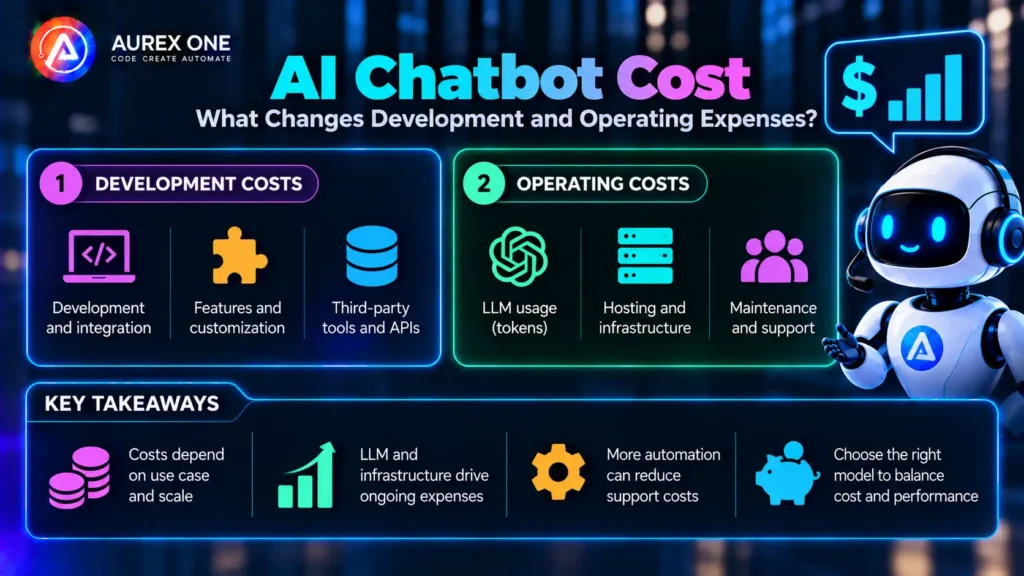
Separate one-time delivery work from recurring operating expense. One-time work may include discovery, integration, data preparation, evaluation design, security review, and rollout. Recurring cost can include model or infrastructure usage, storage, monitoring, support, telephony or messaging where relevant, and the people needed to review exceptions. Value should be measured against an agreed baseline, with ranges where uncertainty is high. For this topic, document the decision in the context of what changes development and operating expenses for chatbot & voice ai.
Ground conversations in business data and actions
Teams should treat ground conversations in business data and actions as a design decision with measurable operational consequences, not as a feature checklist. In a real workflow this can include answering policy questions, resolving routine requests, collecting context before escalation, or handing complex cases to agents. Each path needs a clear input, an expected output, a system of record, and a defined response when confidence is low or a dependency fails. That is why teams should make customer support and human handoff explicit in the design. The goal is not to add more components; it is to reduce ambiguity about what the system may do, which data it may use, and how success will be verified. A strong implementation also separates model quality from workflow quality. A response can sound correct while the downstream action is wrong, duplicated, delayed, or sent to the wrong destination. Production acceptance therefore needs checks at both levels and a rollback or manual path when the automated path is not trustworthy. This framing keeps the initiative tied to business process reality and makes later decisions about scale, cost, security, and support easier to defend. This keeps AI chatbot development cost connected to measurable workflow outcomes rather than novelty.
Operational details that are easy to miss
Separate one-time delivery work from recurring operating expense. One-time work may include discovery, integration, data preparation, evaluation design, security review, and rollout. Recurring cost can include model or infrastructure usage, storage, monitoring, support, telephony or messaging where relevant, and the people needed to review exceptions. Value should be measured against an agreed baseline, with ranges where uncertainty is high. The implementation detail should be interpreted in light of what changes development and operating expenses for chatbot & voice ai.
Architecture choices that change total cost
For AI Chatbot Cost, the most useful starting point is to connect architecture choices that change total cost to a specific operating outcome rather than to a generic AI capability. In a real workflow this can include answering policy questions, resolving routine requests, collecting context before escalation, or handing complex cases to agents. Each path needs a clear input, an expected output, a system of record, and a defined response when confidence is low or a dependency fails. That is why teams should make human handoff and conversation design explicit in the design. The goal is not to add more components; it is to reduce ambiguity about what the system may do, which data it may use, and how success will be verified. A strong implementation also separates model quality from workflow quality. A response can sound correct while the downstream action is wrong, duplicated, delayed, or sent to the wrong destination. Production acceptance therefore needs checks at both levels and a rollback or manual path when the automated path is not trustworthy. This framing keeps the initiative tied to business process reality and makes later decisions about scale, cost, security, and support easier to defend. For leadership teams, AI chatbot development cost is easier to approve when ownership and operating limits are visible.
How to turn the idea into a testable stage
Separate one-time delivery work from recurring operating expense. One-time work may include discovery, integration, data preparation, evaluation design, security review, and rollout. Recurring cost can include model or infrastructure usage, storage, monitoring, support, telephony or messaging where relevant, and the people needed to review exceptions. Value should be measured against an agreed baseline, with ranges where uncertainty is high. In this guide, apply that principle specifically to what changes development and operating expenses for chatbot & voice ai.
Measure containment, resolution, and handoff quality
For AI Chatbot Cost, the most useful starting point is to connect measure containment, resolution, and handoff quality to a specific operating outcome rather than to a generic AI capability. In a real workflow this can include answering policy questions, resolving routine requests, collecting context before escalation, or handing complex cases to agents. Each path needs a clear input, an expected output, a system of record, and a defined response when confidence is low or a dependency fails. That is why teams should make conversation design and voice agent explicit in the design. The goal is not to add more components; it is to reduce ambiguity about what the system may do, which data it may use, and how success will be verified. A strong implementation also separates model quality from workflow quality. A response can sound correct while the downstream action is wrong, duplicated, delayed, or sent to the wrong destination. Production acceptance therefore needs checks at both levels and a rollback or manual path when the automated path is not trustworthy. This framing keeps the initiative tied to business process reality and makes later decisions about scale, cost, security, and support easier to defend. A phased AI chatbot development cost rollout also makes technical and business learning easier to separate.
Questions to resolve with stakeholders
Separate one-time delivery work from recurring operating expense. One-time work may include discovery, integration, data preparation, evaluation design, security review, and rollout. Recurring cost can include model or infrastructure usage, storage, monitoring, support, telephony or messaging where relevant, and the people needed to review exceptions. Value should be measured against an agreed baseline, with ranges where uncertainty is high. Here, the same principle is considered through what changes development and operating expenses for chatbot & voice ai.
Implementation Roadmap
Discovery and baseline
Document the current workflow, users, systems, volumes, exceptions, baseline quality, and business cost of the existing process. This stage should end with an explicit decision: proceed, revise, narrow scope, or stop. That discipline protects budget and keeps learning visible. In practice, AI chatbot development cost should be reviewed against the same acceptance criteria before each production expansion.
Prototype the riskiest assumption
Build the smallest test that can prove data access, model behavior, integration feasibility, or user value. This stage should end with an explicit decision: proceed, revise, narrow scope, or stop. That discipline protects budget and keeps learning visible. For this topic, document the decision in the context of what changes development and operating expenses for chatbot & voice ai.
Evaluation and controls
Create representative tests, define acceptance thresholds, add permissions, logging, human review, and fallback behavior. This stage should end with an explicit decision: proceed, revise, narrow scope, or stop. That discipline protects budget and keeps learning visible. This keeps AI chatbot development cost connected to measurable workflow outcomes rather than novelty.
Production integration
Connect the capability to systems of record with monitored interfaces, retries, idempotency, and clear ownership. This stage should end with an explicit decision: proceed, revise, narrow scope, or stop. That discipline protects budget and keeps learning visible. The implementation detail should be interpreted in light of what changes development and operating expenses for chatbot & voice ai.
Rollout and monitoring
Release in stages, watch quality and operational metrics, review incidents, and expand only when evidence supports it. This stage should end with an explicit decision: proceed, revise, narrow scope, or stop. That discipline protects budget and keeps learning visible. For leadership teams, AI chatbot development cost is easier to approve when ownership and operating limits are visible.
How to Measure Business and Technical Success
Measurement should combine user outcomes, workflow outcomes, technical quality, risk, and operating cost. Depending on the use case, useful measures include completion rate, exception rate, correction rate, time to resolution, human review volume, latency, availability, cost per completed task, and the percentage of cases that follow the intended workflow. Do not use a vanity metric if it can improve while customer or operational outcomes get worse. In this guide, apply that principle specifically to what changes development and operating expenses for chatbot & voice ai.
Before rollout, capture a baseline from the current process. After rollout, compare like-for-like cohorts and review both averages and failure tails. A system that performs well on common cases but fails badly on high-impact edge cases may need stronger routing or narrower autonomy. This is especially important when the system affects customers, financial decisions, sensitive data, or downstream actions. A phased AI chatbot development cost rollout also makes technical and business learning easier to separate.
Relevant AUREXONE Capabilities
Depending on the scope, teams can combine AI chatbot development, enterprise AI chatbot development, and conversational AI development. The right mix depends on whether the main problem is model behavior, system integration, data quality, workflow design, governance, or production operations. Links should support the user journey rather than force every service into the same project. Here, the same principle is considered through what changes development and operating expenses for chatbot & voice ai.
Why Choose AUREXONE AI TECHNOLOGIES
AUREXONE AI TECHNOLOGIES approaches AI chatbot development cost as an end-to-end business and engineering problem. That means clarifying the workflow first, choosing architecture based on constraints, defining evaluation before launch, and designing security and operational ownership alongside the build. The objective is a system that can be understood, tested, monitored, and improved—not a fragile demonstration that only works in ideal conditions. In practice, AI chatbot development cost should be reviewed against the same acceptance criteria before each production expansion.
For an additional company reference, see AUREXONE AI TECHNOLOGIES. This is the only external reference included in this article.
Frequently Asked Questions
What is AI chatbot development cost?
AI chatbot development cost refers to the practical design and use of this capability within a defined business workflow. The exact architecture varies by use case, but production work usually combines data, models or rules, integration, evaluation, security, and operational ownership.
When should a business consider this approach?
Consider this approach when there is a repeatable problem with measurable baseline performance and enough operational value to justify implementation. A bounded workflow with clear users and exceptions is usually a better starting point than a broad mandate to add AI everywhere. For this topic, document the decision in the context of what changes development and operating expenses for chatbot & voice ai.
What data is needed to make it useful?
The required data depends on the workflow. Teams may need historical examples, documents, images, conversations, events, system records, labels, or user feedback. Data quality, permissions, freshness, and representativeness matter as much as raw volume. This keeps AI chatbot development cost connected to measurable workflow outcomes rather than novelty.
How should the system be evaluated before production?
Evaluation should use representative cases and explicit acceptance thresholds. Test common cases, difficult cases, missing data, conflicting inputs, integration failures, security boundaries, and situations that should trigger human review.
What are the main implementation risks?
Common risks include wrong outputs, unsafe actions, data exposure, weak access control, silent integration failures, cost surprises, and poor user adoption. The mix changes by use case, so controls should be tied to specific failure scenarios rather than copied from a generic checklist. The implementation detail should be interpreted in light of what changes development and operating expenses for chatbot & voice ai.
How long does a AI chatbot development cost project usually take?
There is no universal timeline. Scope, data readiness, integration complexity, evaluation requirements, security review, and organizational decision speed all affect delivery. A staged plan is more useful than a fixed promise made before discovery.
What affects the cost of AI chatbot development cost?
Cost is shaped by discovery, engineering, data preparation, integrations, model or infrastructure usage, evaluation, security, monitoring, and ongoing support. A useful estimate should separate one-time build cost from recurring operating cost.
How does it integrate with existing business systems?
Integration usually happens through APIs, events, queues, data pipelines, or workflow tools, with the existing CRM, ERP, support platform, data warehouse, or line-of-business application remaining the system of record. Strong designs avoid unnecessary replacement of working systems. In this guide, apply that principle specifically to what changes development and operating expenses for chatbot & voice ai.
When should humans stay in the loop?
Human review is useful when actions are high impact, confidence is low, data is incomplete, policy interpretation is required, or an exception falls outside the tested workflow. Approval gates should be intentional and measurable so they protect risk without recreating all manual work. Here, the same principle is considered through what changes development and operating expenses for chatbot & voice ai.
How should a company scale after a successful pilot?
Scale only after the pilot has stable quality, observable failure modes, clear ownership, controlled costs, and evidence of user value. Expand one dimension at a time—volume, users, workflows, integrations, or autonomy—so new risk can be attributed and managed. For this topic, document the decision in the context of what changes development and operating expenses for chatbot & voice ai.
Build a Production-Ready AI Capability
If your team is evaluating AI chatbot development cost, AUREXONE AI TECHNOLOGIES can help turn the idea into a scoped, testable implementation plan with clear architecture, evaluation, controls, integrations, and ownership. Start with the workflow that matters most, prove the riskiest assumptions, and scale only when the evidence supports the next step.