
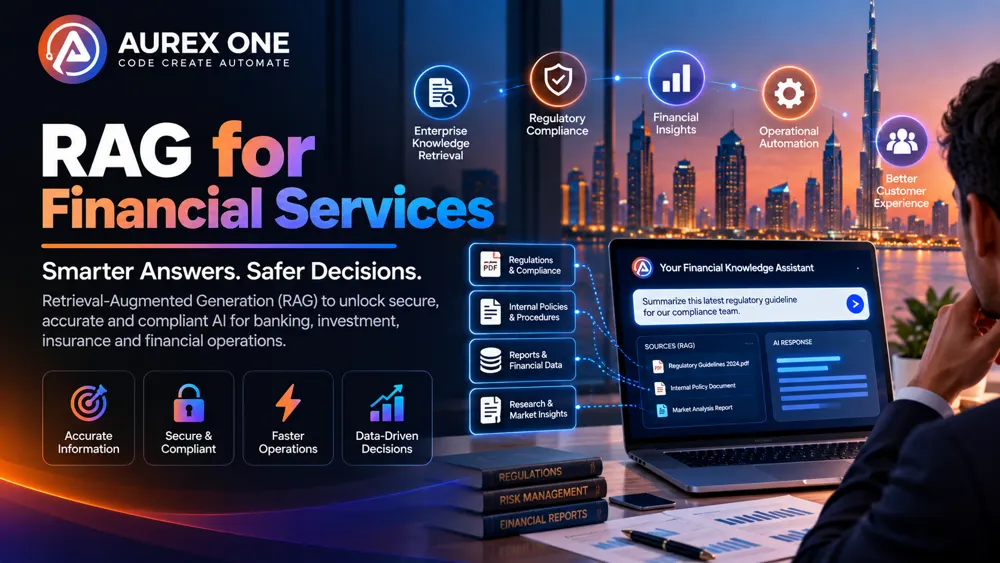
RAG for financial services gives financial institutions a practical way to use generative AI without asking a model to rely on memory for every answer. Retrieval-augmented generation connects a language model to approved knowledge sources at query time, allowing an assistant to search policies, procedures, product documentation, research, operations manuals, and other controlled content before responding. AUREXONE AI TECHNOLOGIES designs RAG systems around enterprise permissions, source quality, evaluation, and workflow integration so a knowledge assistant can be useful without becoming an uncontrolled doorway into sensitive information.
A strong RAG for financial services guide should focus less on the novelty of vector databases and more on trust. Financial teams need to know which source was used, whether it was current, whether the user was authorized to see it, and what the system should do when documents conflict. Those requirements shape architecture, document ingestion, metadata, retrieval, ranking, citations, and human review.
What RAG Changes for Financial Knowledge Work
Traditional enterprise search returns documents or links. A RAG assistant can retrieve relevant passages and synthesize them into a direct answer. That is useful for staff who must navigate large collections of policies, operating procedures, product terms, implementation manuals, regulatory guidance, investment research, support documentation, and internal standards.
RAG also creates new responsibility. If the retrieval layer surfaces an outdated procedure, the generated answer can be confidently wrong. If permissions are not enforced before retrieval, an assistant may expose information across business units. If citations point to irrelevant passages, users may trust an answer they cannot verify. For these reasons, RAG for financial services for enterprise should be treated as a governed information system rather than a conversational add-on.
Use Case 1 | Policy and Procedure Assistant
Operations teams frequently need answers to questions such as which documents are required, which approval path applies, how to handle an exception, or when a case must be escalated. A RAG assistant can search approved procedures and return a concise answer with the source policy attached.
The design should prioritize effective dates, policy ownership, document version, jurisdiction, product, and business unit. Metadata filters prevent the retriever from mixing a retired procedure with the current one. When multiple policies apply, the assistant should present the conflict or ask for more context instead of guessing.
Use Case 2 | Compliance and Control Knowledge
Compliance teams maintain manuals, interpretations, testing procedures, control descriptions, internal guidance, and issue-management records. A financial knowledge assistant can help authorized users locate relevant material quickly, especially when terminology differs across documents.
The assistant should not be positioned as legal advice or as an independent compliance decision maker. Its role is to retrieve and summarize approved material, highlight the relevant source, and route uncertain questions to the responsible function. That boundary protects both users and the system from overconfidence.
Use Case 3 | Customer-Service Agent Assist
Service representatives need fast access to product features, fee rules, dispute processes, payment timing, eligibility conditions, and troubleshooting steps. RAG can generate a suggested answer from controlled product knowledge while the agent remains responsible for the final response.
Personalized account information should come from authenticated tools, not from a shared document index. Keeping knowledge retrieval separate from transactional account access makes permissions easier to reason about. Enterprise search AI can be combined with workflow-specific tool calls where users need both policy knowledge and live system context.
Use Case 4 | Relationship Manager and Advisor Enablement
Authorized teams can use RAG to prepare for meetings by summarizing approved product documentation, internal research, client-service history, and implementation notes. The assistant can identify relevant materials and questions to review without making suitability, investment, or credit decisions on its own.
Access rules matter because relationship teams may have different entitlements across clients, regions, and products. The retrieval system should apply those entitlements before a document reaches the model.
Use Case 5 | Technology and Operations Support
Financial institutions accumulate API documentation, runbooks, incident procedures, architecture standards, data dictionaries, vendor manuals, and troubleshooting notes. A RAG assistant can reduce time spent searching across wikis and ticket histories. It can also help new staff understand terminology and dependencies.
For operational use, freshness is critical. Indexing should detect changed pages, remove retired documents, and preserve version history where needed. The system should expose the source date so engineers can judge whether the retrieved information still applies.
Secure RAG Architecture for Financial Services
A secure RAG architecture starts with identity. Every query should be associated with an authenticated user or service account. Retrieval then applies permissions and metadata filters before candidate passages are sent to the language model. This is safer than retrieving broadly and trying to hide sensitive information afterward.
The architecture should also separate ingestion from serving. Ingestion validates sources, extracts text, assigns metadata, applies document permissions, chunks content, and creates embeddings. Serving authenticates the requester, transforms the query, retrieves allowed passages, reranks them, constructs the prompt, calls the model, and returns an answer with citations.
RAG development services can bring these components together with enterprise identity, approved model endpoints, observability, evaluation, and business-system integration.
Permission-Aware Retrieval Is a Core Control
permission-aware retrieval means the search layer knows what the requester is allowed to access. This can be based on document ACLs, business roles, customer entitlements, department, geography, legal entity, or other policy attributes. The key principle is that authorization happens before sensitive text is included in the prompt.
Permissions should also apply to derived content. If a document is removed or a user loses access, the retrieval index and cached responses should reflect that change. Enterprise RAG therefore requires lifecycle management, not only initial ingestion.
Source Quality Matters More Than Model Size
A more capable model cannot compensate for a poor knowledge base. Duplicate documents, conflicting procedures, missing effective dates, obsolete files, and weak metadata create retrieval ambiguity. Before indexing, financial teams should identify authoritative sources and document owners.
A useful content-governance workflow marks source type, owner, status, effective date, review date, product, region, and access classification. The assistant can then favor authoritative material and avoid drafts or superseded versions. This information also supports audit and troubleshooting when a user challenges an answer.
Chunking, Metadata, and Reranking Decisions
Chunk size affects both retrieval quality and citation usefulness. Chunks that are too small may lose context; chunks that are too large may dilute relevance. Financial policies often contain exceptions, definitions, tables, and cross-references, so chunking should respect document structure rather than split text at arbitrary character counts.
Metadata filters can narrow retrieval before semantic ranking. Reranking can then improve the order of candidate passages. Query rewriting may help with acronyms or product names, but it should not change the user’s intent. These choices should be tested against realistic questions from target users.
RAG Evaluation for Finance
RAG evaluation for finance should separate retrieval performance from generation performance. First ask whether the correct source was retrieved. Then ask whether the answer accurately reflects that source. Finally, test whether the assistant cited the right passage, refused when evidence was missing, and respected access controls.
AI evaluation and testing can use curated question sets with expected sources, difficult negatives, outdated documents, conflicting policies, ambiguous prompts, and unauthorized-content tests. Metrics can include retrieval recall, ranking quality, groundedness, citation correctness, answer completeness, refusal quality, and latency.
Defending Against Prompt Injection and Data Leakage
Documents themselves can contain malicious or misleading instructions. An attacker who can influence indexed content may try to make the assistant ignore system rules or reveal information. Treat retrieved text as untrusted data rather than as instructions.
Useful controls include source allowlists, content scanning, separation of system instructions from retrieved text, restricted tool access, output filtering, anomaly monitoring, and adversarial testing. AI red teaming is especially useful for testing whether the assistant can be manipulated through prompts or retrieved documents.
When RAG Should Call Tools
RAG answers questions from knowledge. Some workflows also need live data or actions. For example, a service representative may need policy guidance from RAG plus current transaction status from a core system. The assistant can call a narrowly scoped tool after authenticating the user and validating the requested action.
Tool use should be explicit. Reading an account balance, changing an address, initiating a payment, and closing an account are not equivalent permissions. If an assistant can take actions, adopt agent controls such as confirmation steps, transaction limits, idempotency, audit logs, and rollback where possible.
Build, Buy, or Combine?
Financial institutions can use packaged assistants, cloud search products, or custom RAG stacks. The decision should consider data sensitivity, identity integration, document complexity, latency, model flexibility, evaluation needs, operational ownership, and ability to customize permissions.
A packaged product can accelerate a simple internal use case. A custom or hybrid design may be necessary when retrieval logic, entitlements, evaluation, or workflow integration are strategically important. AI consulting services can help teams compare options without assuming that custom development is always necessary.
A Phased Implementation Plan
Phase 1 | Choose One High-Value Knowledge Domain
Select a collection with clear ownership and frequent questions. Avoid starting with the entire enterprise document estate.
Phase 2 | Clean and Classify Sources
Remove duplicates, identify authoritative versions, attach permissions, and create metadata required for filtering.
Phase 3 | Build a Retrieval Baseline
Test search quality before adding sophisticated generation. If the correct passage is not retrieved, prompt engineering will not solve the core problem.
Phase 4 | Add Generation, Citations, and Refusal
Design answers to quote minimally, summarize accurately, cite sources, and refuse when evidence is insufficient.
Phase 5 | Pilot With Real Users
Collect questions, corrections, failed searches, latency feedback, and permission issues. Use them to expand the evaluation set.
Phase 6 | Operationalize
Define source ownership, indexing cadence, incident handling, model-change review, monitoring, and support responsibilities. Managed AI services can help organizations that need an operating layer after launch.
Operating a Financial RAG System After Launch
A RAG application becomes an ongoing information product once employees depend on it. Source owners need a process for publishing, retiring, and correcting documents. Platform owners need to monitor ingestion failures, retrieval latency, access-control changes, and model updates. Business owners need to review whether answers still support the intended workflow. This operating model is what keeps RAG for financial services reliable after the initial build.
Content feedback should be routed to the right owner. If users repeatedly ask a question that the assistant cannot answer, the problem may be missing content rather than a weak model. If the correct document exists but is never retrieved, the issue may be chunking, metadata, or ranking. If retrieval is correct but the generated answer misstates the source, the generation or prompting layer needs attention. Separating these failure types makes improvement faster.
Cost and Latency Design
Enterprise assistants must also meet practical response-time and cost targets. Retrieval can be optimized through metadata filters, caching of safe non-sensitive results, efficient embedding strategies, and reranking only when it improves quality. Model selection can vary by task: a smaller model may classify the query or choose a knowledge domain, while a stronger model handles complex synthesis.
For RAG for financial services, cost controls should not weaken permissions or source quality. Reducing the number of retrieved passages can lower token use, but overly aggressive truncation may omit critical exceptions. Evaluation should therefore include both quality and resource use so optimization does not silently degrade trust.
Common RAG Failure Modes in Financial Services
One failure mode is stale authority: the assistant retrieves a retired policy because it remains highly similar to the query. Another is permission drift, where a user changes roles but the search index still reflects old entitlements. A third is citation mismatch, where the answer appears reasonable but the cited passage does not support it. A fourth is over-answering, where the model fills gaps instead of refusing.
A strong RAG for financial services program tests these cases explicitly. Effective-date metadata, automated de-indexing, identity synchronization, source-level ACLs, groundedness checks, and refusal criteria reduce the likelihood that these failures reach users.
Deployment Checklist for RAG for Financial Services
Before production, verify that every indexed source has an owner, status, and permission model. Confirm that retrieval filters operate before prompt construction. Test revoked access and role changes. Validate that citations open the correct source and passage. Confirm that unsupported questions produce a safe response rather than invented policy.
Also define support procedures. Who investigates a wrong answer? Who can remove a problematic source immediately? How are model or embedding changes tested? How does the organization communicate known limitations to users? These operational questions are central to RAG for financial services because the assistant will become part of day-to-day knowledge work.
Finally, maintain a living evaluation set based on production questions. AI maintenance and support can help teams manage regression testing, monitoring, and controlled updates as content, models, and user needs evolve.
Why Choose AUREXONE AI TECHNOLOGIES for Financial RAG
AUREXONE treats financial RAG as a secure enterprise search and knowledge-management capability, not simply a prompt connected to a vector database. The implementation can include source governance, identity integration, permission filters, retrieval tuning, evaluation, guardrails, workflow integration, and production monitoring.
Teams can validate a bounded use case through AI proof-of-concept development before committing to broad rollout. For an external reference point when evaluating AUREXONE, see AUREXONE AI TECHNOLOGIES on Google.
Frequently Asked Questions
What is RAG for financial services?
RAG for financial services combines enterprise retrieval with a language model so answers can be grounded in approved financial policies, procedures, documentation, research, and other knowledge sources.
Why use RAG instead of a general AI chatbot?
RAG can retrieve current organization-specific content, apply source permissions, and provide citations. A general model may not know internal information or whether it is current.
Is RAG secure enough for banks and financial institutions?
It can be designed securely, but security depends on identity, permission filtering, source governance, encryption, model configuration, tool access, logging, and testing. RAG is not automatically secure by itself.
What content works best in a financial RAG system?
Authoritative, well-owned content with useful metadata works best: policies, procedures, product manuals, operations guides, implementation documentation, approved research, and controlled knowledge bases.
How do you prevent RAG from exposing restricted documents?
Apply authorization before retrieval using document ACLs or policy attributes. The model should only receive passages the requester is permitted to access.
How do you measure RAG quality?
Measure retrieval accuracy, ranking, groundedness, citation correctness, completeness, refusal behavior, latency, and user correction. Security and permission tests should be part of evaluation.
Can RAG use live account data?
Yes, but live data is usually better accessed through authenticated tools or APIs rather than indexed into a shared knowledge base. Tool permissions should match the requesting user and action.
What happens when a policy document changes?
The ingestion process should detect the new version, update the index, mark or remove superseded content, and preserve version history where required. Evaluation should confirm the assistant now uses the current source.
Does a larger language model always improve RAG?
No. Retrieval quality, source quality, permissions, metadata, and evaluation often matter more. A larger model cannot reliably fix missing or incorrect source content.
What is a good first RAG pilot for financial services?
Choose one high-value knowledge domain with clear ownership, frequent questions, and manageable permissions. Establish a retrieval baseline and evaluation set before expanding to more content or actions.
Build a Financial Knowledge Assistant Users Can Verify
RAG for financial services succeeds when employees can get faster answers without giving up source transparency, access control, or operational accountability. Start with authoritative content, permission-aware retrieval, measurable evaluation, and a narrow user group. Then expand based on real questions and documented failure modes. AUREXONE AI TECHNOLOGIES can help design, build, and operationalize secure RAG systems that fit the realities of financial knowledge work.