
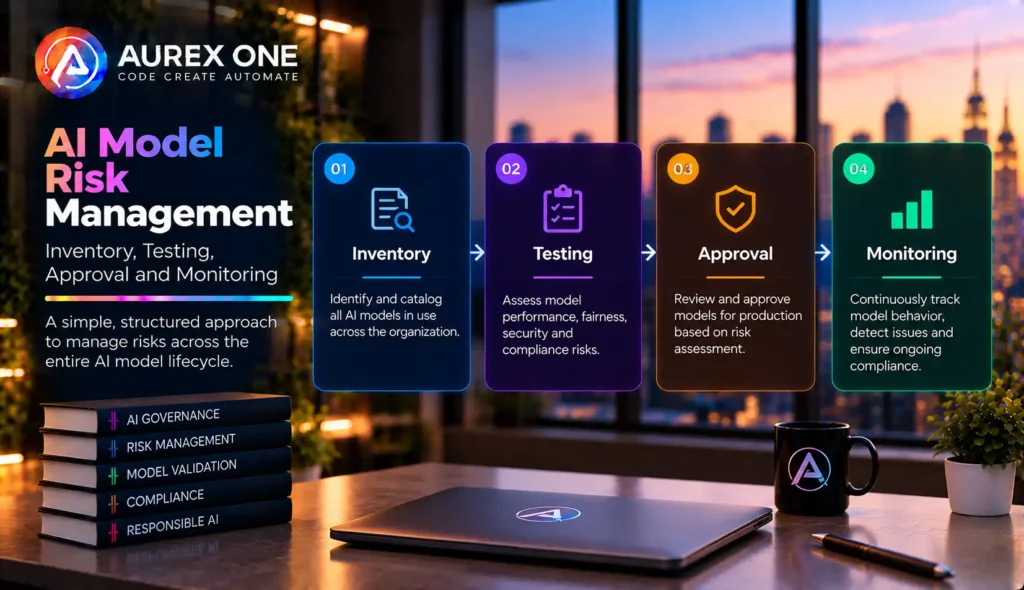
AI model risk management becomes useful when the workflow, data, controls and success measures are defined before technology choices harden. AUREXONE AI TECHNOLOGIES works from that production-oriented perspective, helping teams move from an idea to a scoped workflow, technical design, evaluation plan and operating model without treating a polished demo as proof of readiness. This guide explains what the topic means, where it creates value, what to validate, which risks deserve attention, and how buyers can compare implementation choices without relying on unsupported ROI promises.
For organizations across markets, the important question is not whether AI can produce an impressive response. The question is whether AI model risk management can work with the real data, permissions, users, exceptions and systems involved in the target process. Organizations should design the solution around the laws, sector requirements, data locations and operating practices that apply to their own deployment. The practical goal is a design that produces evidence early, keeps humans in control where necessary, and has a clear route to monitoring and improvement.
What AI model risk management Means in Practice
In practical terms, AI model risk management is a governance discipline for identifying AI systems, classifying material risks, documenting controls, approving deployment, and monitoring behavior after release. That definition matters because teams often scope an AI initiative around a vendor, model or interface before they have defined the decision or workflow being improved. A production design starts with who is doing the work, what information they need, which actions are permitted, how exceptions are handled, and what evidence is required before the system can be trusted.
From an evidence-led delivery perspective, the most relevant concepts for this topic include AI governance, AI security, LLM guardrails, evaluation, monitoring, model drift. These terms should not be treated as separate buzzwords. They describe connected parts of the same operating problem: value, data, architecture, risk, adoption and ongoing ownership. When those parts are evaluated together, the initiative becomes easier to compare across vendors and easier to govern after launch.
Where AI model risk management Creates the Most Value
The strongest use cases for AI model risk management are usually bounded workflows where the current process has visible friction, repeatable inputs and a measurable outcome. Instead of starting with “where can we use AI?”, teams can start with work that is slow, inconsistent, hard to search, expensive to route, or dependent on repetitive judgment. The following patterns are especially useful for scoping discussions.
1. Maintain an ai inventory with owners and purpose
This pattern applies when maintain an AI inventory with owners and purpose. For this use case, the design should define the source of truth, the user or system that receives the output, the acceptable error path, and whether a person must review the result before anything consequential happens. A narrow implementation is usually more informative than a broad demo because it exposes integration, exception and adoption issues early.
2. Set risk tiers based on data, autonomy and business impact
This pattern applies when set risk tiers based on data, autonomy and business impact. For this use case, the design should define the source of truth, the user or system that receives the output, the acceptable error path, and whether a person must review the result before anything consequential happens. A narrow implementation is usually more informative than a broad demo because it exposes integration, exception and adoption issues early.
3. Require testing evidence before approval
This pattern applies when require testing evidence before approval. For this use case, the design should define the source of truth, the user or system that receives the output, the acceptable error path, and whether a person must review the result before anything consequential happens. A narrow implementation is usually more informative than a broad demo because it exposes integration, exception and adoption issues early.
4. Monitor drift, incidents and control effectiveness
This pattern applies when monitor drift, incidents and control effectiveness. For this use case, the design should define the source of truth, the user or system that receives the output, the acceptable error path, and whether a person must review the result before anything consequential happens. A narrow implementation is usually more informative than a broad demo because it exposes integration, exception and adoption issues early.
Architecture and Integration Requirements for AI model risk management
Architecture for AI model risk management should be driven by the workflow and risk level, not by a default stack. The core building blocks typically include system inventory and ownership records, evaluation evidence and approval gates, model and prompt version tracking, plus incident, monitoring and audit workflows. The objective is to keep the AI component replaceable where possible while protecting business logic, permissions and data contracts from unnecessary vendor coupling.
Integration work is often the difference between a useful prototype and a production system. A model can only act on what the surrounding application exposes, so identity, APIs, source-system rules, retries, idempotency, error handling and human approval paths matter as much as prompt design. Teams evaluating AI model risk management should ask how the system behaves when a dependency is unavailable, an input is incomplete, a user lacks permission, or an output does not pass validation. Those scenarios are part of the architecture, not edge cases to solve after launch.
Implementation Roadmap From Discovery to Production
Step 1 | Define the workflow and baseline
Using an evidence-led delivery lens, document the current process, users, inputs, decisions, handoffs, exceptions and baseline performance. This establishes what must improve and prevents a model demo from becoming the success metric. This stage should end with evidence and a decision, not just activity.
Step 2 | Validate data and access
For an evidence-led delivery approach, confirm that representative data can be accessed lawfully and securely, that permissions are understood, and that data quality is sufficient for the intended task. This stage keeps the initiative tied to measurable acceptance criteria instead of subjective impressions.
Step 3 | Prototype the riskiest assumptions
In an evidence-led delivery review, test the technical unknowns with representative cases. Use evaluation criteria that reflect the real workflow, including difficult and failure examples. This stage keeps the initiative tied to measurable acceptance criteria instead of subjective impressions.
Step 4 | Integrate with production systems
With an evidence-led delivery mindset, connect the AI capability to the systems, identity controls and operational queues that make the workflow useful. Design retries, validation and escalation explicitly. The output should make the next investment decision clearer and easier to audit.
Step 5 | Launch with measurement and ownership
For this evidence-led delivery decision, release to a controlled user group, monitor quality, latency, cost and exceptions, and assign owners for incidents, model changes and continuous improvement. This stage keeps the initiative tied to measurable acceptance criteria instead of subjective impressions.
Security, Privacy and Governance for AI model risk management
Production AI model risk management needs controls that match the consequences of a wrong answer or action. Common risks include unknown AI assets, inconsistent approval criteria, tests that do not match real workflows, and monitoring that detects issues without a response owner. A useful risk review asks what data enters the system, what leaves it, which tools the model can reach, how permissions are enforced, how outputs are validated, what is logged, how long records are retained, and who can stop or override the workflow.
Because requirements differ by sector and jurisdiction, governance should be tied to the actual data, users and decisions in scope rather than a generic compliance checklist. This is an informational implementation guide rather than legal advice. Organizations considering AI model risk management should confirm the obligations that apply to their data, sector, locations and processing model with qualified legal, privacy and security professionals. Technical controls and documentation should then be aligned to those requirements rather than copied from a generic checklist.
Cost, Timeline and Operating Economics for AI model risk management
There is no responsible universal price for AI model risk management because the cost depends on the workflow, data, integrations and production controls rather than the label on the project. The main cost drivers are number of AI systems in scope, depth of testing and documentation, integration with security and risk tools, and ongoing monitoring and review cadence. Buyers should separate discovery, build, integration, evaluation and launch work from recurring model usage, infrastructure, monitoring and support so that a low initial estimate does not hide the long-term operating model.
Timeline should also be staged around evidence. A focused discovery and technical validation can retire uncertainty before a broader build begins, while production work should include security review, integration testing, user acceptance, evaluation and operational handoff. For AI model risk management, a credible proposal explains assumptions and dependencies instead of promising a fixed schedule before data access and integration constraints are understood. That approach makes scope changes visible and gives leadership clearer choices about speed, quality and risk.
How to Evaluate Performance and Business Value
Model quality is only one layer of evaluation. Useful measures for the initiative include inventory coverage, evaluation pass rate by risk tier, time to remediate control gaps, and post-release incident and exception trends. Teams should measure the end-to-end workflow because a high-quality model can still create a poor product when retrieval is weak, integrations fail, latency is excessive, users do not trust the output, or exceptions are routed badly.
From an evidence-led delivery perspective, a practical evaluation plan has an offline layer and a production layer. Offline tests use representative examples, difficult cases and known failure modes before release. Production measurement tracks accepted outcomes, user corrections, escalation, latency, cost and incidents after release. Together, these measures help teams decide whether the system should be expanded, redesigned, constrained or stopped. They also create evidence for governance reviews and future vendor comparisons.
Buyer and Technical Due-Diligence Checklist
- Can the team explain the target workflow, non-goals and acceptance criteria in plain language?
- Is data access realistic, permission-aware and representative of production conditions?
- Does the architecture include validation, human review, logging, retries and incident handling?
- Are quality, cost, latency and business outcomes measured together?
- Can the organization change models or vendors without rebuilding all business logic?
- Are ownership, documentation, support and exit responsibilities explicit?
Using an evidence-led delivery lens, when buyers compare proposals for this kind of AI work, they should ask for the reasoning behind the architecture and evaluation plan, not only screenshots or model names. A strong delivery plan makes trade-offs visible, describes how failure is handled, and shows how the system will be operated after the initial team leaves. Relevant AUREXONE capabilities include AI governance consulting, AI security, guardrails and evaluation, and AI evaluation and testing. These links are most useful when the corresponding capability is actually part of the project rather than being forced into every implementation.
Practical decision note 1
For AI model risk management, one useful planning lens is to connect the use case “maintain an AI inventory with owners and purpose” directly to a known risk such as unknown AI assets. The implementation team should decide what evidence would show that the risk is controlled, then track a measure such as inventory coverage after release. This prevents scope from being driven only by feature requests. It also makes the effect of number of AI systems in scope visible during planning, so leadership can choose where to simplify, where to invest in stronger controls, and where a human step remains the better design. In a multi-market deployment, the same decision should be reviewed against the organization’s actual data locations, users, contracts and sector obligations before the workflow is expanded.
Why Choose AUREXONE AI TECHNOLOGIES for AI model risk management
For an evidence-led delivery approach, aUREXONE AI TECHNOLOGIES can support the initiative from discovery through architecture, implementation, evaluation and production handoff. The useful distinction is not a claim that one model or framework is always best; it is the ability to connect business requirements to data access, integrations, measurable evaluation, security controls and a maintainable operating model. For buyers, that means the engagement can be structured around evidence: define the workflow, validate the riskiest assumptions, build the smallest production-worthy slice, measure real outcomes, and expand only when the system demonstrates value and control.
Frequently Asked Questions
What is AI model risk management?
AI model risk management is a governance discipline for identifying AI systems, classifying material risks, documenting controls, approving deployment, and monitoring behavior after release. In this article, the practical boundary is the workflow rather than the model itself, with set risk tiers based on data, autonomy and business impact used as a representative planning pattern.
When should a business invest in this AI capability?
Investment is most defensible when a defined workflow has meaningful friction, an accountable owner and a measurable outcome. For this topic, require testing evidence before approval is a useful example, while evaluation pass rate by risk tier can help show whether the change is actually working.
What data is needed for AI model risk management?
Representative data is required for the real task, together with permissions, metadata and access rules. The design should pay particular attention to evaluation evidence and approval gates and test for a risk such as inconsistent approval criteria before broad rollout in the target operating market.
How should the system be evaluated before launch?
Evaluation should combine representative offline tests with production measures. A useful plan connects time to remediate control gaps to explicit failure cases, human-review rules, cost and latency expectations so the system is judged on end-to-end performance.
What are the main implementation risks?
Risk depends on the workflow, but this topic should explicitly consider inconsistent approval criteria and tests that do not match real workflows. Controls should be proportionate to the consequence of failure, tested before launch and assigned to an operational owner.
How much does AI model risk management cost?
There is no universal price. Cost is shaped by depth of testing and documentation, integration with security and risk tools, integration work and recurring model or infrastructure usage. A staged estimate is more credible than a single number before the data and workflow are understood.
How long does implementation usually take?
Timeline depends on scope, data readiness and integration complexity. Work involving model and prompt version tracking may change the schedule materially, and production delivery also needs testing, security review, user acceptance, monitoring and operational handoff.
How do integrations affect the project?
Integrations determine whether the capability can function inside the real process. The team should connect set risk tiers based on data, autonomy and business impact to identity, source-system rules, retries, permissions and escalation so failures do not silently create downstream errors.
What should buyers ask a vendor about AI model risk management?
Buyers should ask how the vendor handles tests that do not match real workflows, how it measures evaluation pass rate by risk tier, how ownership is transferred, and how the architecture can evolve when models or business requirements change. Production reasoning matters more than a polished demo.
How should a company scale after a successful first release?
Scale only after quality, cost, controls and support are stable. Use time to remediate control gaps as one expansion signal, keep depth of testing and documentation visible as usage grows, and re-check governance whenever the workflow gains new data, users or autonomy.
Plan the Next Step
If your team is evaluating AI model risk management, start by defining one workflow, one accountable owner, the data and systems involved, and the evidence required to justify the next investment stage. AUREXONE AI TECHNOLOGIES can help turn that scope into an implementation plan covering architecture, integrations, evaluation, governance and production operations. You can also review AUREXONE AI TECHNOLOGIES as the single external reference included in this article.