

Your customers and employees expect mobile experiences that are simple, useful, and dependable. Aurex One offers mobile app development services focused on turning business ideas into practical mobile applications. From customer-facing apps to internal business tools, we help plan custom mobile app solutions around your users, workflows, and long-term goals.
Whether you’re launching a new product or extending an existing platform, the right approach starts with understanding what your application needs to accomplish.
Create mobile experiences designed around iPhone users and their expectations. Our approach to iOS app development services emphasizes intuitive navigation, clear user journeys, and platform-appropriate functionality. App features and technical requirements are defined based on your audience, business objectives, and deployment needs.

Reach Android users with an application designed for practical everyday use. Android app development services require attention to device compatibility, screen sizes, performance, and user experience. We help define the application features and technical considerations that matter for your intended audience.

When you need to reach both iOS and Android users, cross-platform app development may offer a practical alternative to maintaining separate applications. Technology choices depend on required features, device access, performance expectations, and long-term maintenance needs.

Support daily operations with business mobile app development tailored to real workflows. Applications may include employee portals, service management tools, appointment systems, and internal reporting interfaces. The goal is to make important business tasks accessible and easier to manage on mobile devices.

A useful mobile application often depends on the systems behind it. Mobile app backend development and API integration for mobile apps can connect user accounts, databases, existing business software, and selected third-party services. Integration requirements are evaluated according to available APIs, permissions, and security considerations.

Start with essential features before investing in a larger application. Minimum viable product (MVP) development helps businesses validate a focused app concept, while modernization can address outdated interfaces, changing requirements, or technical limitations in an existing product.

A clear development process helps transform an initial idea into a practical application while keeping important decisions visible throughout the project.
We begin by understanding your business goals, target users, required features, and existing technology. This initial mobile app development consulting stage helps define project priorities and determine whether an iOS, Android, or cross-platform approach best fits your requirements.
We plan intuitive user journeys, screen layouts, and application functionality. Effective mobile UI/UX design helps people complete tasks without confusion, while mobile app architecture considers data handling, integrations, maintainability, and technical constraints.
Development turns approved requirements into working features. Depending on the project, implementation may involve user interfaces, authentication, mobile app backend development, databases, and API connections. Progress reviews help confirm that the application matches agreed business needs.
Before release, mobile application testing should evaluate important features, device compatibility, usability, and performance. Deployment planning includes release requirements, documentation, and any agreed mobile app maintenance and support arrangements after launch.
Plan practical mobile experiences, build around approved requirements, test on relevant devices, and prepare for release.
Whether you’re exploring a new mobile product or improving how your team works, the right development plan begins with clear priorities.
Aurex One can help you discuss your app concept, identify essential features, and evaluate suitable development options. Our mobile app development services focus on practical applications that address real business requirements.
Every mobile application has different users, features, and technical requirements. Aurex One focuses on understanding those differences before recommending a development approach.
Our approach to custom mobile app development services considers the entire application experience, from initial requirements and usability to integrations, testing, and future improvements.
Rather than recommending unnecessary features, we focus on functionality that serves a clear business purpose.

Our mobile app development services can help businesses explore applications for different operational needs.
Give customers a convenient way to request services, manage appointments, or access account information.
Create mobile shopping experiences that organize products, customer accounts, and purchasing workflows.
Support field teams and employees with mobile access to relevant tasks, records, and operational information.
Explore mobile app development for startups by prioritizing core features, gathering feedback, and planning future product releases.
Consider enterprise mobile app development services for workflows involving business-system integrations, user permissions, and organizational requirements.
Help users manage reservations, appointments, notifications, and scheduling activities through a dedicated mobile interface.
A successful mobile application should help users complete important tasks without unnecessary friction.
From clear navigation to responsive interfaces and reliable system connections, good application development requires attention to both usability and technical quality.
Aurex One’s approach to mobile app development services emphasizes practical functionality, thoughtful planning, and development decisions aligned with business needs.
The right mobile experience is not defined by the number of features it contains, but by how effectively those features support the people using it.
Mobile app development services involve planning, designing, building, testing, and preparing applications for mobile devices. Projects may include customer applications, internal business tools, or digital products developed for iOS, Android, or both platforms.
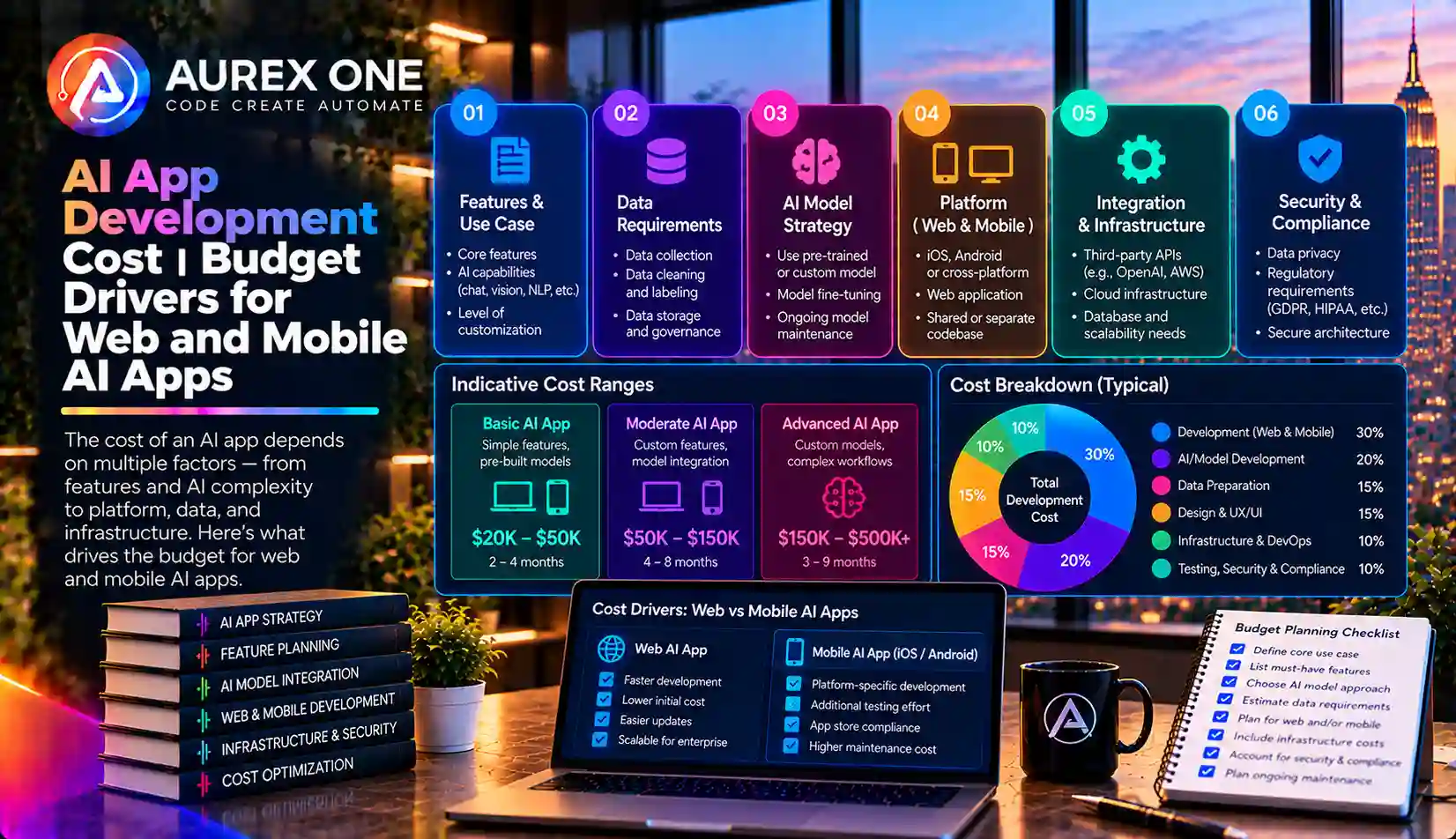
The cost of mobile app development depends on features, platform requirements, design complexity, backend systems, integrations, and testing. A basic application and a complex enterprise platform require different levels of work. A clear scope is needed before estimating the investment.
Development time depends on the number of features, selected platforms, integrations, design requirements, and testing needs. A focused MVP typically requires less work than a feature-rich application. A realistic schedule should be established after reviewing the project's scope and technical dependencies.
The native vs cross-platform mobile apps decision depends on technical needs. Native apps are built specifically for individual platforms, while cross-platform approaches allow some code to be shared between iOS and Android. Each option has trade-offs involving development effort, performance, platform features, and maintenance.
Start with the platform most relevant to your target users. Consider customer device preferences, business goals, geographic markets, and available resources. If both audiences are important, evaluate whether separate native apps or a shared cross-platform approach makes sense.
Yes. Cross-platform app development can support iOS and Android using a shared codebase. However, some features may still require platform-specific implementation, testing, or configuration.
Flutter app development uses Google's Flutter framework to create applications for multiple platforms from a shared codebase. It can be suitable for many mobile interfaces, although project-specific integrations and device features may require additional native development.
React Native app development uses a React-based framework to create mobile applications for iOS and Android. It supports shared application logic and native platform interfaces, but some requirements may involve native modules or platform-specific code.
Swift app development is commonly associated with native iOS applications, while Kotlin Android development is widely used for Android. The appropriate language and framework depend on the selected platform and technical requirements.
A minimum viable product is an initial usable version of an application containing the features needed to deliver its core value. MVP development allows businesses to gather feedback and validate assumptions before investing in a larger feature set.
Yes. API integration for mobile apps can connect supported business systems, databases, CRM platforms, and other applications. Compatibility depends on available APIs, authentication requirements, data formats, and access permissions.
Mobile app development for small businesses can be useful when customers or employees need frequent mobile access to important services. However, a mobile-friendly website or existing software may be more economical when a dedicated application offers limited additional value.
Before you hire mobile app developers, prepare a clear explanation of your app idea, target users, core features, preferred platforms, existing systems, and budget expectations. A detailed technical specification is helpful but not always necessary for an initial discussion.
When evaluating a mobile app development company, consider relevant experience, understanding of your business requirements, development process, testing practices, communication, and post-launch arrangements. Request clear information about deliverables, code ownership, and ongoing responsibilities.
Mobile UI/UX design affects how easily users navigate the application and complete tasks. Clear layouts, readable content, consistent interactions, and accessible controls can reduce confusion and make the application more useful.
Mobile application testing may include functionality, usability, compatibility, performance, security, and integration checks. Testing on relevant devices and operating-system versions helps identify issues before customers or employees begin using the app.
Applications can be submitted through the appropriate developer accounts after meeting the relevant technical, content, and policy requirements. App Store and Google Play publishing involves platform-specific review processes, so approval and publication dates cannot be guaranteed.
After release, an application may require bug fixes, security updates, monitoring, compatibility improvements, and new features. The exact mobile app maintenance and support arrangement should be defined before or during project delivery.
Yes. An existing application may benefit from interface updates, technical improvements, new integrations, or app performance optimization. A technical review can help determine whether improvements are practical or a larger rebuild is necessary.
Not every application needs a complex backend. Apps requiring user accounts, synchronized data, administrative controls, or external integrations often rely on backend services. The architecture depends on the app's functionality and data requirements.
Security planning should address authentication, permissions, secure communication, appropriate data storage, and access to backend services. Privacy requirements and applicable regulations should also be considered, especially when handling sensitive information.
Yes, additional functionality can often be introduced after launch. However, future changes may require updates to application architecture, interfaces, APIs, and testing. Planning for likely growth can make later development easier.
Have an app idea, an outdated mobile product, or a business process that could work better on smartphones?
Tell Aurex One what you’re trying to achieve, who will use the application, and which features matter most.
Let’s explore how mobile app development services can support your next digital project.
Partner with us to create intelligent, impactful, and future-ready AI solutions together.
Copyright © 2026 Aurex One™. All rights reserved.